
This year I attended my first International Trumpet Guild conference, which was held in Salt Lake City in late May. This was the 49th annual conference, which is one shy of what I can only imagine will be a huge anniversary bash, but it was a good idea in retrospect to go to a slightly smaller one first before jumping into the big one.
That being said, it sounds like this one wasn’t small at all, there was a LOT going on. I tried to make it to as many things as I could, but when the schedule goes from 7:30am until 11:30pm every single day, that’s simply not gonna happen. I ended up not making it to any of the 7:30 warm-up sessions or 10pm jam sessions, instead focusing on the core of the workshops and concerts throughout the day, and maybe attempting to even get some sleep in between?
Here’s a quick run-down in order of everything that I attended:
Opening Fanfare
We started late afternoon on Tuesday with a rehearsal and outdoor performance of our opening number, which is viewable on Instagram here (I’m the fifth person in from the left, almost completely obscured from this angle). From what I recall, you had to agree to play in this separately. I wasn’t sure if any of the higher level guest artists were going to participate, but it seems most of them don’t do these “community” performances, just their own.
Parts weren’t assigned in advance, so I printed off all 8 parts and prepared them all. When I get to rehearsal, with probably a hundred trumpet players crammed into a tiny room, our conductor Terry Everson asked “Who here is playing trumpet 1?” and, much to everyone’s amusement, only like four hands went up. So, I put mine up too and ended up on 1st, which is very funny.
Concert – Terry Everson and the Utah Symphony Brass
Terry Everson teaches at Boston University, and was the soloist for the first half of our opening concert. His setlist was mostly made up of duets with vocalists, including an absolutely beautiful arrangement of Rachmaninoff’s “O, Cease thy Singing Maiden Fair,” ending with a killer trumpet and piano reduction of “Zurucke, zurücke, geflügelten Winde” from Bach’s lesser known BWV 205.
For the second half, the Utah Symphony brass ensemble performed Jay Friedman’s arrangement of Strauss’ Alpine Symphony, a work that I always thought was a little over the top, even for Strauss. And yes, it was certainly a lot! But in the best way, it was about half an hour of WAILS and WALLS of sound.
Session – Unlocking Potential: Teaching Trumpet from Baby Teeth to Adult Smiles
My first session on Wednesday morning was with Kyra Sovronsky, who teaches Suzuki trumpet in the SLC area, and her topic was on strategies for teaching students as young as 4 years old, when most teachers don’t start until around 10 years old. It involves lots of colours, stickers, positive reinforcement, toys as props and memory aides, and parental involvement. At one point, she even gave away five of these musical dice to five people who could give her a way to use them other than their intended purpose. Surprisingly, everyone else who answered was fixated on the letters, so I thought my answer of playing catch and breathing in and out with your motions was a nice stand out! Though I’m not taking as many students currently and doubt I’ll go that low in age in my teaching (it actually takes more prep time per student the younger you go), some of the principles of ear training are going to make it in to my lessons with beginner players.
Session – Accommodating Neurodivergence in Music Pedagogy: Success Through Empathy
Next, I attended a session with Dr. Joe Nibley, professor at Fort Lewis College in Colorado. He told a story of his personal struggles of making it through academia with undiagnosed ADHD, and explained some common symptoms and struggles that exist between people with various diverse neurological conditions. Unfortunately I had to leave this one early to attend a Festival rehearsal, but the general principles of finding different strategies that work to the needs and strengths of different students are well worth diving in to deeper.
Session – Latin Trumpet 101
After a lunch break, I went to a class with Dr. Oswaldo Zapata, a Colombian trumpet player who teaches at the University of Texas in San Antonio. He gave an overview of several different genres of Latin and Central American music, and highlighted some common errors and misconceptions that non-Latin players make when attempting these genres, especially Mariachi (and accidentally calling other genres Mariachi is one of them!). He also gave strategies for practicing the required vibrato and articulation for these styles.
Session – Orchestral Section Playing
The next session I went to was a masterclass put on by Tom Hooten, principal trumpet of the Los Angeles Philharmonic Orchestra. He took four groups of advanced students who had never played with each other to coach them on some prominent trumpet section excerpts: Shostakovich 5, Don Quixote, Brahms Academic Festival Overture, and I’m sure there was one more but I can’t remember what it was, I’ll edit it in when I think of it. His focus was most prominently on balance and articulation, on blending as a section even when it’s your first day there.
Recital – William Leathers
The first solo recital I attended late afternoon on Wednesday was with Canadian trumpet player William Leathers, who recently won the job as principal trumpet of the Nashville Symphony. William is really on a quick rise to stardom, and I wouldn’t be surprised if he was soon uttered in the same breath as Tom Hooten, Michael Sachs, and Phil Smith. I particularly enjoyed his rendition of Steve Rouse’s The Avatar, which he played in honour of his teacher Ray Mase, and the first movement of his own co-composition, Digital Trumpet Odyssey.
Concert – University of Utah Wind Ensemble
The last thing in what was, if you can believe, still only my first full day(!) was a concert with the UofU wind ensemble. Three guest trumpet soloists were featured, and the ensemble’s principal trumpet even got a moment to himself, absolutely nailing the tricky extended solo in Charles Ives’ Variations on America. The standout piece was a new composition commissioned in honour of the Guild’s 50th anniversary by Omar Thomas, performed by soloist Sean Jones, who after this event has become one of if not my favourite living trumpet players. The piece, entitled Metatron’s Cube, is a no holds barred, balls to the walls concerto for trumpet and wind ensemble that takes no prisoners, and was an easy highlight of the concert for any metalheads in the audience.
Session – Exploring the Narrative Voice of the Trumpet
After an absolutely packed Wednesday, I allowed myself to sleep in slightly later on Thursday, so my first session was mid-morning. I walked into the concert hall to find a large acrobatics frame set up. The performers were Briana Gillet, flugelhorn; Carina Gillet, acrobatics; and Nora Price, electronics. They performed two routines, one fully improvised and one that seemed about 70/30 choreographed and improvised, in a style I can best describe as Cirque du Soleil meets Stockhausen (positive). They took a few volunteers from the audience up to improvise as well, so you can bet that I went up there!
Session – Recording Production and Technology
Dr. Emily Tourgeman currently teaches at Southwestern University, though her presentation was not what I was expecting at first. Rather than being a recording engineer who works with trumpet players, she’s a trumpet player who gave a testimonial of her journey learning to make music videos as someone with no previous experience. Her highlighted video is this recording of her performing the Vivaldi A minor violin concerto most famously recorded by Alison Balsom, and the tools, methodology, and software she used to make it happen.
One embarrassing yet funny story: during this process, she was studying with Dr. Caleb Hudson at the University of Texas at Austin, who was in the audience and she would gesture to him frequently. Except I somehow got a wire crossed in my brain, and every time she did, I would think to myself “where is Chris Coletti I can’t see him.” It took until nearly the end of the session before I realized I was looking for the wrong former member of Canadian Brass.
Session – New Approaches to New Music
Something Something Trumpet is a contemporary small ensemble consisting of Dovas Lietuvninkas, Bailey Paugh, and Demian Spindler, that brings concerts of intense avant-garde music to very public places, such as bars and art shows. They talked about their experience of performing “academic” and unconventional music to masses of people who have never heard it before, many of them reacting even more positively than musician circles do. Throughout the workshop, and several very good performances and demonstrations, they kept reiterating their main point: “audiences are hungry for something new.”
Recital – Tom Hooten
The second of three sessions with Tom Hooten I attended was his solo recital, where he performed a great selection of repertoire. The John Williams concerto is one of my favourites, and though sadly a piano reduction can’t do it justice, his execution and sound was phenomenal throughout. Though the surprise highlight of the concert was Geoff Stradling’s Prix Fixe, in which, after the linked recording was filmed, Tom managed to bully the composer into adding a drum kit part, to wonderful effect.
Concert – Kellin Hanas and Bria Skonberg
Unfortunately, due to the current US administration, the planned performance of the ensemble Venezuela 7/4 was cancelled due to their agent advising them against travel. Instead, Friday afternoon’s jazz recital with Kellin Hanas and Bria Skonberg was moved to Thursday evening, and I’m glad it was as I wasn’t sure if I’d make it on the Friday. Kellin Hanas has got “next big thing” written all over her, she’s crafting a unique sound concept that’s great to listen to.
Concert – New Works Recital #2
Friday was always going to by my day to peruse the exhibit halls, but unfortunately due to me misreading the schedule I ended up at the wrong venue for the mass band rehearsal for Saturday’s festival, so I went to the new works recital instead. Apparently this is the first time they’ve managed to fit two recitals into the schedule! Of particular note was the piece The Hopes and Dreams of Flightless Birds by Nathan Hudson, which my wife lovingly joked I would relate strongly to. And, unfortunately, she’s right, it was my favourite.
The Exhibit Halls
There were, of course, several sponsors present, all gunning to sell every conference participant their new high end trumpet. Maybe the funniest thing I discovered about myself is that I do, in fact, have the preference for Bach trumpets that I thought I did! In no particular order, here are some other instruments I really enjoyed trying out:
* Maller Baroque Brass Instruments makes reproduction Baroque natural trumpets using historically informed techniques, as well as some modern trumpets using the same techniques. Of note, I felt his modern E-flat was a cut above, and am considering purchasing one in the future, even if you can only really use it for the big 3 concertos.
* Lots of companies have very cool satin gold, rose gold, and colourful instruments, but of all the eye-striking instruments there, the Adams B-flat was the one I resonated with the best.
* I tried all the Yamaha models, and they have enough variety that everyone should find an instrument that works best for them, but if you wanted a recommendation, the YTR-8335LAS is my personal favourite.
* I had also meant to try out some cornets, and ended up forgetting, which is a shame. However I did try a few flugelhorns, and there was a raw copper bell that had an absolutely beautiful sound. I think it was the Adams F5, but the one I tried looked more raw than the stock photos. Hopefully one will be there again next time, because if I ever upgrade, this is the one I’ll get.
* Apparently I missed that the Bach Artisan Bb line has been discontinued, because they decided the Stradivarius line is good enough that they either can’t or don’t need to go higher, which is actually a pretty gutsy move on their part.
Unfortunately, I missed James Vaughan’s recital due to a conflict with a Festival rehearsal, and then deciding to go farther away for dinner to avoid the fairly pathetic food options near the campus, but please enjoy this recording instead.
Recital – Sergei Nakariakov
This was, I imagine, the highlight of almost everyone’s conference. Sergei Nakariakov is simply one of the most skilled musicians of any instrument to exist right now, and in all possible parallel universes, no alternate version of Sergei could have done better than our universe’s Sergei did on Friday night.
Now, I’m going to refer quickly to Jens Lindemann’s story about his first lesson with Mark Gould, which you can listen to here. I have a confession to make: it’s me. I am the meathead. Sergei has such a beautiful flugelhorn sound, inhumanly perfect accuracy, and a delicate soft range, but I would have liked one, just one note that was forte. Most of his music was string music, which may have contributed, and is also probably why the standout piece for me was the Schumann Adagio and Allegro.
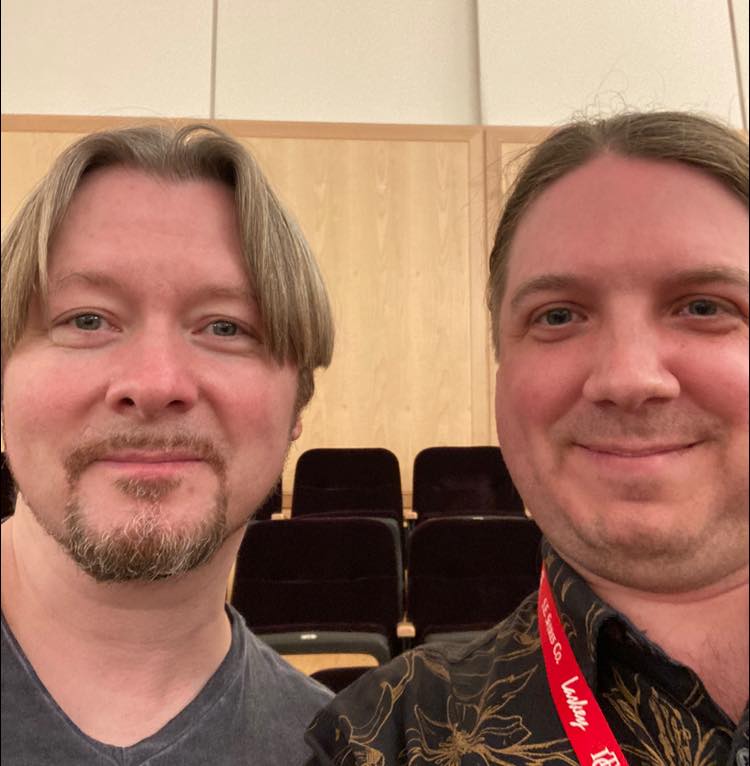
Anyways, he stayed an extra day to play in Caleb Hudson’s recital when the latter’s trombone player couldn’t make it, and he’s genuinely the friendliest guy and was willing to take pictures with everyone.
Concert Clinic – Alias Brass
First thing I had to do on Saturday was a dress rehearsal for the Festival, but I had some time between the dress and the concert, so I made it to this brass quintet lecture/recital with Alias Brass. Formed by horn player Natalie Brooke Higgins and trumpet player Jonathan Bhatia, the ensemble is a touring brass quintet who were formerly artists in residence at the Banff Centre and are all some serious players. They take a lot of inspiration from Canadian brass in their light-hearted banter between pieces, and they really hammered home that what makes and breaks the hundreds of formed and broken-up quintets that graduating university students try to form every year is commitment to the lifestyle and making it work within each member’s career goals.
Festival of Trumpets
The other concert I got to participate in was the Festival of Trumpets, an outdoor collage of trumpet ensembles that were formed from scratch for this event. My piece was called Rex Tenebris, and luckily for me, was the piece that fit my particular skills and strengths best out of everything on the programme. We ended with a very loud arrangement of 1812, though I suppose not as loud as the original, we didn’t have cannons.
Session – Make Space for Joy
One session I almost missed, but was very glad I didn’t, was this workshop by Wiff Rudd, trumpet professor at Baylor University, and Dr. Micah Killion, from the University of Texas at Austin. They talked about the concept of finding joy at work, which should seem obvious to non-musicians when thinking about music as a career, but is often not the case for real full-time classical musicians. They shared some survey data on how trumpet players in various fields find or lose joy at work, and told some stories about how having the right mindset to approach a problem can diffuse stress and cause us to remember why we all love music again.
Session – Common Ground: The Truth Between Different Approaches
The final session I attended of the conference was also the third session with Tom Hooten, and it aimed to look at some of the big trumpet method books and figure out what they have in common. The chosen books were Stamp, Clarke, Schlossberg, Caruso, Franquin, and Dauverné, which all seem very different at first, but Tom’s point was this: most of us don’t even read the text, we just skip straight into the exercises! If you read the text, it gives important context to all exercises contained within, especially Caruso which is often considered the “muscle” book. Every single one of them prioritizes the same thing: the breath, the buzz, and making sound easily. Every exercise in the Clarke book is piano, after all!
There was time for questions afterwards, and I was particularly struck by Tom’s overly honest answer to one question. The question was: “If you have an audition with hundreds of applicants, and you have twenty people who can all do the job, how do you choose?” Tom’s answer was brutal but also thought-provoking: “That doesn’t happen. There won’t ever be twenty people who can do the job.” Now of course he’s approaching this from the frame of Los Angeles, not the Sticks-ville symphony, but it strikes me as intense to claim that at any given time, there are actually LESS people who are qualified looking for open orchestra positions than there are positions, not more? It seems like the opposite of conventional wisdom, but I think that was his wake-up call to people that they’re underestimating how good you have to be to get a job like that. I’m not fully certain I agree with him, but maybe his point is also “if they’re good enough they’ll have gotten something else already”?
Recital – Caleb Hudson
Dr. Caleb Hudson performed yet another string-heavy programme, half of which he arranged himself, though his recital was probably the most technically demanding out of all of them, and his ease on the trumpet (especially piccolo), contrasted with Sergei’s on flugelhorn, was brought to a delightful zenith when they performed the Mendelssohn Trio in D minor together. My standout favourite piece, though, was GG by Shai Maestro.
Concert – United States Army Blues
The final event of the conference was a big band concert with members of the US Army, and boy, do they have some killer trumpet players in their line-up. Despite Wayne Bergeron being on the bill, he wasn’t there, but the soloists they did have could have headlined the whole conference on their own if they wanted to. Summer Camargo opened her setlist with an impeccable impression of Louis Armstrong on a much harder arrangement of Portrait of Louis than the one I played two years ago, and Sean Jones was back with a vengeance to show everyone why he’s the best in the business. A wonderful and loud finale to a wonderful and loud conference.
 Matt Richard