
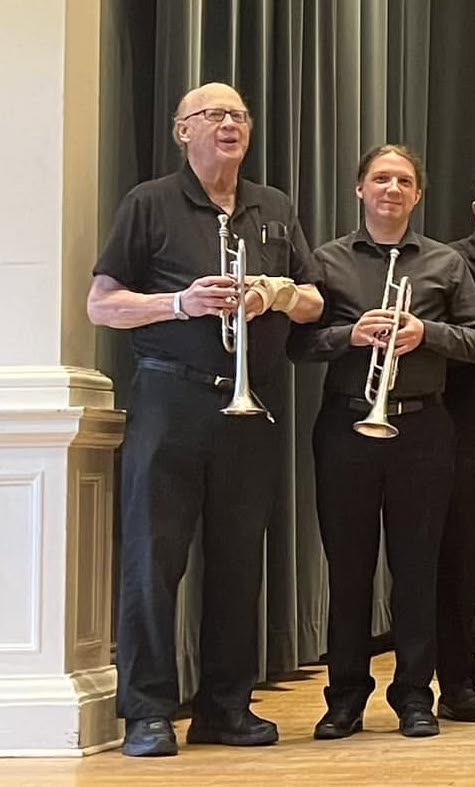
On October 15th, 2024, trumpet player and instructor Jeffrey Stern passed away after a quick decline caused by his ongoing battle against cancer. Jeff was my trumpet teacher for five years, four during my undergrad degree and one during my gap year before grad school. Jeff and I had a very good relationship as teacher and student, and we remained bandmates and good friends for the rest of his life.
Jeff studied with three teachers, though I can’t recall the name of the first one. His teacher during high school was Harry Herforth, a Mager student who played for the Cleveland Orchestra. His third teacher for both his undergrad and grad degrees, and his lifelong idol, was Roger Voisin, a French trumpeter who was principal of the Boston Symphony for a number of years.
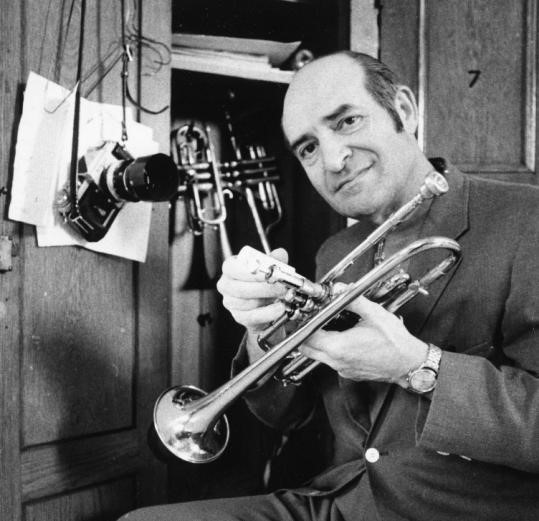
There were a few points about Jeff’s teaching in his last few years at Dalhousie University that were controversial among both brass students and his colleagues, but maybe the most apparent one was that his belief about a good trumpet sound was locked in one moment in time. In the French-styled orchestras of the American east coast, the sound was very bright, narrower than the more broad German-styled orchestras like Chicago, with very strong articulation on every note. It’s a sound that hasn’t been in favour basically at all in the 21st century, but it’s the sound that Jeff played and taught, which drew behind-the-back criticism from some other faculty members.
In fact, the one most valuable thing I learned after switching teachers was the importance of a broad, full, resonant sound. Then, one of the most valuable things I learned on my own, without a teacher to guide me, was the importance of being able to adapt your sound to the task at hand, so you don’t walk into a big band gig with the same sound as a chamber orchestra gig and vice-versa.
But while they’ll come up for the sake of story-telling, this list isn’t meant to be a deconstruction of Jeff’s idiosyncrasies. Rather, this is a celebration of my most treasured knowledge from my lessons with Jeff, some of which are things you wouldn’t hear from anyone else. These are five big lessons from Jeffrey Stern that I’d like to pass along to you now.
Lesson 1: Triangles and L’s
I knew very little about classical repertoire when I started my undergrad, so I presumed most of the music I’d be playing would be similar to what you find in the RCM books for piano. However, there’s very little trumpet repertoire from the common practice period, and baroque music is typically played on smaller horns that most 18 year olds haven’t invested in yet, so the bulk of the repertoire that Jeff taught falls under a category that I jokingly refer to as “mid-century modern.” It’s that post-Hindemith style of tonality that follows a different set of rules than the music before it, but still is comfortably within the classical genre.
The two most prominent pieces of the genre that Jeff taught were sonatas by Kent Kennan and Halsey Stevens. Both are wonderful works, and I considered the Stevens sonata my “signature piece” for many years. Both pieces feature many new but manageable challenges for an aspiring performance major, which I eventually became. One of those challenges is mixed meter.
Sometimes I joke with my students that when time signatures are changing rapidly, the way I keep on the beat is by counting “one and one and one and one and…” so I don’t have to follow the changes. This is a bit of an exaggeration, but it works decently well if the beat remains constant. So, what if the beat doesn’t remain constant?
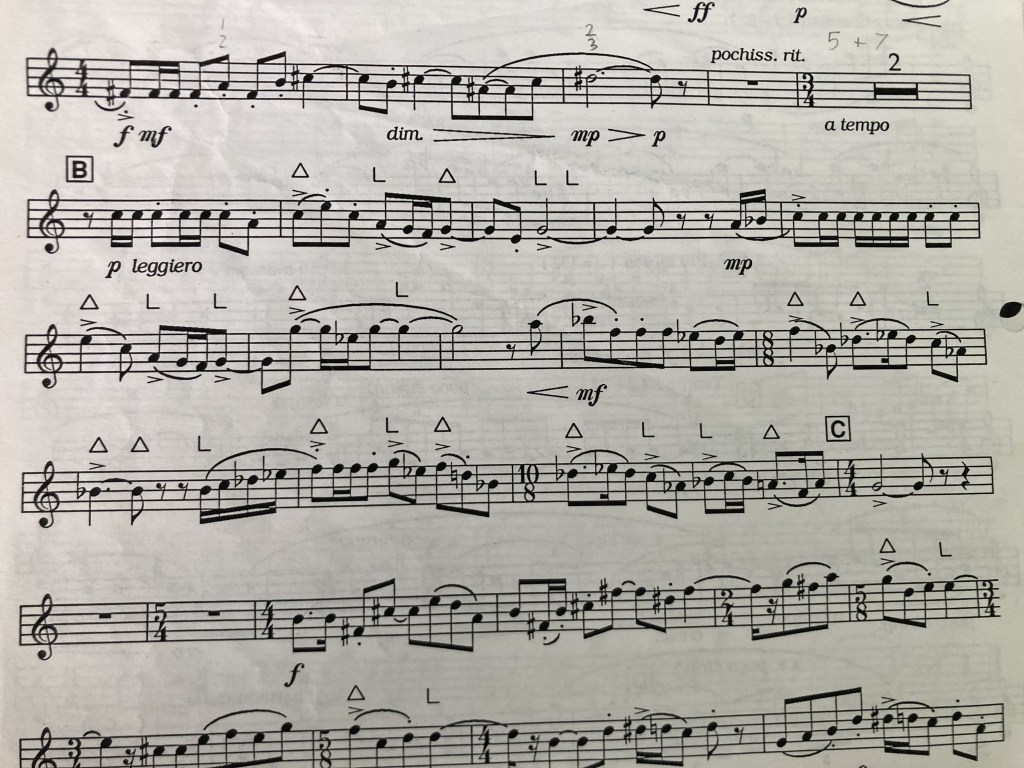
That’s where triangles and L’s come in. All you have to remember is that every beat will be either two subdivisions long, or three subdivisions long. So, by writing your triangles and L’s above the music, you can remain locked in to the changing beat, and it makes mixed meter a breeze. I know that if I write my triangles and L’s in a new work before I play it, I’ll never miss a rhythm.
Lesson 2: Lean your bike into the turn
I don’t think Jeff ever played an offbeat late in his entire life. He really drilled rhythm as the most important aspect of music in his lessons, and with that came tricks for ensuring you remained locked in and never late. For offbeats, it was a simple trick: anticipate slightly. If you have to make a turn on a bike, you need to lean into it so you don’t fall, and with rhythms he did the same thing. Sometimes I felt it was a little too much, he ended up quite far ahead of the beat occasionally! I try not to over-correct, but my goal is to be never late.
I play with a few community ensembles, and humorous consequence of this lesson is that sometimes the whole band has to come in on a syncopation or offbeat together, and I end up noticeably ahead of the group because everyone’s playing late! Of course, I typically concede because majority rules, but in my head, I know Jeff would never concede and remain perpetually ahead of the group. When he thought or knew that he was right, he would never back down, no matter if doing it slightly wrong would benefit the group in a pinch.
Lesson 3: The ninth harmonic is your friend
One of my first lessons with Jeff, he told me he found where A440 was on each of his instruments, marked the tuning slide with a pen, and left it there. He would proudly declare that his tuning slide hadn’t moved in decades, to which I never asked what he did if the instrument that a group was tuning to wasn’t at A440, because I definitely knew the answer already.
Jeff really believed in the idea of using alternate fingerings to aid with intonation, which caused some friction between one of the low brass teachers, who mocked this idea with “just play in tune.” Now each of them DID have a point: to Jeff’s point the instrument is not built to be in tune and adjustments need to be made, and to the other teacher’s point, you should be able to make most adjustments on the standard fingerings.
Above the door to Jeff’s studio, there were three Bristol board posters, which he referred to as “the tapestry” of the most important things on the instrument. Two of them aren’t actually in this article otherwise, but they are as follows:
“90% of playing the trumpet is mental”
“Ta ta ta ta ta ta ta ta ta ka ta ka ta ka ta ka”
And the third (technically second) one, “the ninth harmonic is your friend.” Realistically, all this meant was that D above the staff should be played open, and C-sharp above the staff should be played with 2nd valve alone.
However, I’ve expanded this idea a little bit. When I teach my students, there are the normal fingerings, there are alternate fingerings (such as 3rd valve A), and then there are what I call “secret fingerings.” Really the only difference between an alternate fingering and a secret fingering is how common or practical they are. An alternate fingering is something you can use relatively often, and isn’t too unreasonable to expect another person to know. A secret fingering is something that most people would never think of, and would have almost no real-world applications, but when you do find a use for it, it’s a lifesaver. A great example is B in the staff on 1st and 3rd. You virtually never need this note in real life, but the one time you have to trill B-flat to C-flat, it’s a lifesaver. That actually happened in a rehearsal last year, the player I taught it to was blown away!
So what does this have to do with the ninth harmonic? Well, it’s the home of two of my favourite secret fingerings: B-flat above the staff on 2nd and 3rd, and B above the staff on 1st and 2nd. The longer amount of pipe on those notes gives them a certain resonance and power that sound fabulous when it’s appropriate. My favourite example is in the Arutiunian trumpet concerto, using 2nd and 3rd on the B-flat in the introduction really helps give the tone the drama you need for the moment. You can also hear me play B on 1st and 2nd twice in the Hindemith sonata here. Try it out sometime!
Lesson 4: Walk down and f*ck them all
This is a real “parable” that Jeff told me as an 18 year old in my first year of music school:
An old bull and a young bull were standing on top of a hill.
The young bull said to the old bull, “hey, let’s run down to the field and fuck one of them cows.”
“No,” said the old bull wisely, “let’s walk down, and fuck them all.”
Now of course I wasn’t used to teachers using foul language, so that came as a bit of a shock to me! When I tell this parable to my students it’s much cleaner, involving two children at a playground and an ice cream truck. But either way, the point is the same: it’s about endurance and pacing yourself.
I learned this the hard way in my third year of undergrad. I wasn’t a performance major, I was taking a general BA, but I decided that since I wouldn’t get a degree recital, I would put on my own. And BOY, did I programme WAY TOO MUCH music. I’m talking six full pieces, and though I don’t remember it all, it included: the Bloch Proclamation, the Bissell Little Suite, an entire Telemann oboe sonata, one movement of Hindemith, and it ENDED with the entire Arutiuniuan concerto. Needless to say, I was barely able to make a sound by intermission, and I muddled my way through the second half barely clinging to life, or so it felt.
Jeff used to refer to some people as Supermen. Roger Voisin was a Superman. Bernie Adelstein, principal trumpet in his hometown of Cleveland, was a Superman. (At the time, he was on record as claiming Michael Sachs was not a Superman, but I think most would not agree with that statement) However, most of us aren’t Superman, and we need to be smart about the way we program our concerts, about not overblowing our chops, and generally keeping our eyes smaller than our stomachs when it comes to how much we put on our musical plates.
Lesson 5: Transposition and fluency
Like all teachers, Jeff would make his students practice scales. However, I quite liked his definition of how scales work: the goal is to make every key feel automatic. If you’re playing in A major, you press the A major button in your head, and your fingers start playing in A major without having to think too hard about it. And of course, what method book is better than the Clarke technical studies to gain that kind of ingrained facility required? My students know that I consider Clarke and Arban’s to be the two best methods, and while he barely ever mentioned Arban’s, we used Clarke all the time.
I was pretty strong at music theory when I was in undergrad, which meant when I got into second year, Jeff gave me his transposition method. It’s about a dozen pages long and each page is a SOLID WALL of text, so I’ve used it as a base to make my much friendlier secret art of transposition handout. And Jeff didn’t hold back when it came to drilling students: once you learned a few transposition, he would start shouting out keys every time you got to a rest in your etude, and you’d have to change keys immediately on the fly. It was a significant mental challenge!
When it came to other sizes of trumpets, it’s funny how Jeff and my grad school teacher Louis Ranger had exactly opposite approaches that still kind of ended at the same result. When Jeff was younger, he bought three of the same Bach C trumpets, and had a tech friend cut two of them down into a D and E-flat, so that he could switch horns at his discretion to play in his preferred key, while keeping the tone the same. Lou, meanwhile, would say that any piece can be played on a B-flat no problem if you practice your scales, so why bother switching for facility’s sake? If he owned different horns, it was because they have different timbres, and he would choose the horn that had his preferred timbre. At the end of the day, both of them were transposing for the sake of facility, but facility in what varied between the two.
When I was studying at the University of Victoria, I never claimed nor pretended that I was the strongest trumpet player in the studio, because I wasn’t. However, one thing I did boast about was that I was the best at sightreading while transposing, which is true, and that’s thanks to Jeff’s rigorous transposition method.
Bonus lesson: Never let the assholes get you down
Jeff also had two “life” lessons to add on to his swath of trumpet lessons. First: don’t burn your bridges. The music community is too small, especially here in Atlantic Canada, to make enemies. I found this a little ironic as Jeff was the kind of person who could hold a grudge for ages. I know that he was deeply involved with the musician’s union when the Atlantic Symphony Orchestra folded, and he held a deep resentment to the way the situation was handled and the way the former players who were not hired back after the rebirth of the organization were treated until the day he died.
The other is, never let the assholes get you down. People will have their opinions about you, your abilities, your quirks, and your musical sense. Some of those opinions will be well-informed, many won’t. Some people can back up their opinions with their own musical abilities, many can’t. Some people will adapt with the times, others won’t. What other people think about you shouldn’t affect your self-worth, that’s their own problem. I think he knew when he was liked and disliked, and that didn’t stop him from being himself.
In Conclusion
When it comes to Jeff’s teaching, I think about two of my classmates, one who thrived and one who struggled, and now I know why: Jeff had a rigorously structured lesson plan, and taught the same topics to all students in the same order, solving every problem with the same solution. If you were having the problem Jeff expected you to have, great! He had the solution for that. If you were having a different problem, unfortunately Jeff would give you the solution to the problem he thought you should be having, not the problem you were having, which caused some students to struggle.
In my case, there were many significant challenges he helped me with, and some lessons in which I was able to really thrive (see transposition above), but there were also some significant blind spots I really needed addressed earlier in my education.
Even then, I think Jeff did have ways of addressing them, he just spent much less time on them than on some other topics he was more passionate about. One of the first things I learned, “DTR – dull, tight, ring” was the usual lesson of playing in the centre of the note. However, he talked about it sparingly, whereas I do pitch bend exercises with my students all the time. He was a teacher that worked really well for people having very specific problems.
I remember walking into the first lesson after my first year jury. I got a C+. He pulled out the rubric, pointed at a B-, said “this is the grade you need to continue in trumpet,” then pointed at C+, and said “this is what you got.” That year, I signed up for summer lessons, he never addressed the fact that I woefully underpaid him for that time, and I went through a significant embouchure reset. Over the next four years, I went from someone who thought I’d become an academic, to someone who managed to get into a masters in performance. I remember Jeff was very proud of our progress in those several years, and I’d like to think he considered me a minor success story. And that’s one thing I did find: he was always right there for his students, and would give everyone a chance, no matter how unlikely they were.
Some people eat the same breakfast cereal every day of their lives. Jeff Stern played the same variation of Stamp exercise 4a for his entire life. It’s important to have those routines to keep you going, and music kept him going until the very end. Hats off to you, Jeff.


I really enjoyed this, Matt. Jeff and I did our education degree at the same time. I remember thinking he was VERY “unique”. He was significantly older than the rest of the class (we were all early 20s). I enjoyed reading about your education with him.
LikeLike